Reply To:
Name - Reply Comment
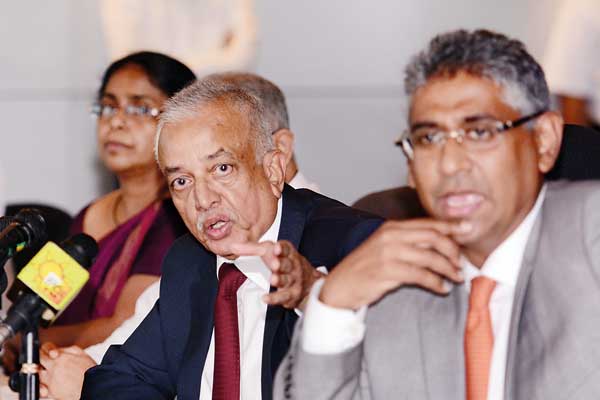 Development Strategies and International Trade Minister Malik Samarawickrama (left) and Provincial Councils and Local Governments Minister Faizer Musthapha
Pic by Pradeep Pathirana
Taking another interesting twist surrounding the controversial trade and services pact with India, the government yesterday said the Economic and Technological Cooperation Agreement (ETCA) would go ahead without the provisions for free labour movement between
the two countries.
“We won’t even talk about Mode 4. There will be no talk on the free movement of people,” Development Strategies and International Trade Minister Malik Samarawickrama told a press briefing yesterday.
When requested, Samarawickrama pledged that the Framework Agreements for the ETCA and the Free Trade Agreements (FTAs) of China and Singapore—developed with the consultation of leading business chambers—will be published on the ministry website in all 3 languages
within 2-3 days.
It appears that the government has succumbed to the growing pressure from multitude of professional associations who took up the cudgels against a sinister move to open up the Sri Lankan labour market for Indians. Professional associations insisted that ETCA—a legacy of the Comprehensive Economic Partnership Agreement that failed to be signed—will bring Indian professionals, including doctors, accountants etc. in droves to Sri Lanka.
Under the original ETCA Framework Agreement, the government had said that professionals with skills not available or in critically low in supply in Sri Lanka, such as shipbuilders and IT professionals with credentials recognized here, will be allowed to come on a quota basis.
“The President told me to tell you in the strictest terms that there won’t be any loss of Sri Lankan jobs through ETCA. There will be no foreigners coming to work here through these agreements,” Provincial Councils and Local Governments Minister Faizer Musthapha said.
He noted that foreigners may only work in Sri Lanka through the existing platform, where the Board of Investment has to give approval.
“We have kept telling them (professional associations) that there will be no foreigners coming here from ETCA, but they go around saying that foreigners will be coming here. They’re trying to create a political platform. What can we do about
it?” he asked.
Musthapha added that nothing will be kept secret.
“We won’t sign these in secret. We will show all these agreements to the public,” he said.
Samarawickrama added that all trade agreements will be tabled in parliament for 1 month for debate, and has invited all political parties to join a working committee to evaluate the negotiations.
Meanwhile a Chinese delegation will be visiting Sri Lanka from August 2-4, and the Singaporean delegation is likely to visit following the initial discussions on ETCA with India on August 9-10.
Samarawickrama said that there are no set agendas or targets to be reached in the initial negotiations, which will include representatives from business chambers.
“We’re going in with an open mind. Not going in with any plans as such. We want to expand our exports, we want investors to come here, we want technology to come in and for our people to have better skills,” he said.
Samarawickrama said that the government is hoping to finalize the Free Trade Agreement (FTA) with Singapore, and the Economic and Technological Cooperation Agreement (ETCA) with India before the end of 2016, while the FTA with China will be finalized before March 2017.
He added that the country’s first International Trade Policy will be developed alongside the negotiations, with the proceedings influencing
each other.
“The International Trade Policy will be finalized by the end of August,” he added.
He went on to say that past problems of the Indian FTA, and any regional government obstructions in China and India to the upcoming agreements will be addressed with an ‘Early Harvest’ clause in the framework to solve these issues before signing the final agreements. “The central governments are aware of the situations of regional governments, and these will be addressed in Early Harvests,” he added.
Meanwhile Trade Negotiations Committee Member K. J. Weerasinghe noted that the Framework Agreements will have some products that will be duty free immediately, while some will have high tariffs that will reduce over time and become tariff
free in 3-5 years.
Negotiating trade agreements in such haste is not going to adversely affect Sri Lanka in the future, an official said.
“It all depends. We can have five negotiation meetings over one year, while others may have those five meetings over five years. Or we could have those five meetings in one month. It depends on the effort put in,” the proposed Agency for Development Managing Director (Designate) Mangala Yapa said.
Developed countries engage in negotiations for FTAs over several years, at times running over 10 years to evaluate potential effects of removing tariffs.
Yapa, the former CEO of the Ceylon Chamber of Commerce, accepted that long-drawn negotiations allow for gathering of more background information.
“But there are people who meet, get married in two days and live happily, and those who have known each other for five years, got married, and divorced soon,” he said in a lighter vein.