Reply To:
Name - Reply Comment
By Nishel Fernando
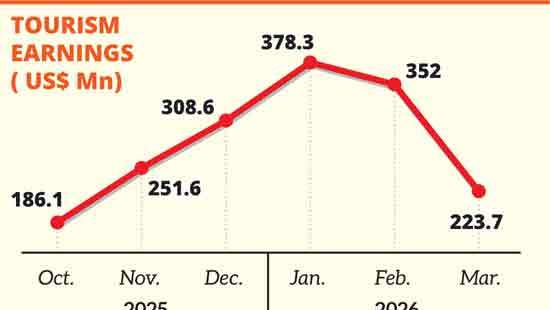
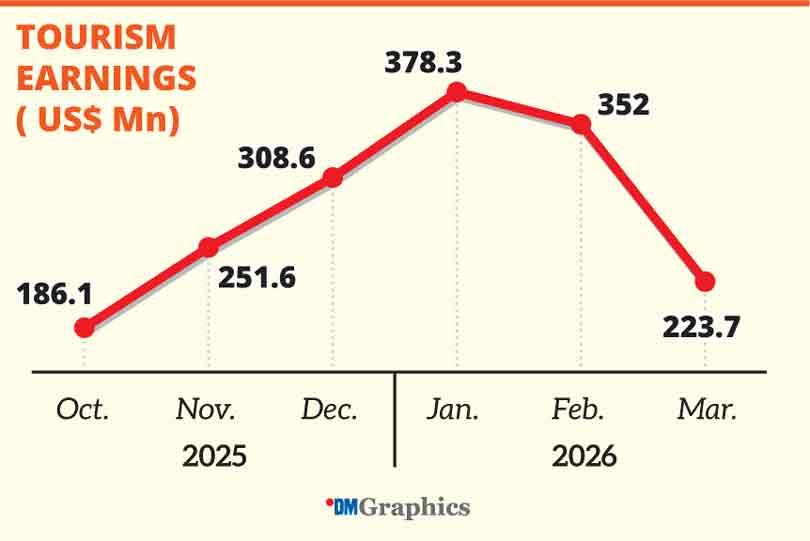
Sri Lanka’s foreign exchange earnings from tourism suffered a severe blow in March 2026, plummeting 37 percent year-on-year to US$ 223.7 million.
This marks a sharp contraction from the US$ 352 million recorded in February and the US$ 378.3 million generated in January, dragging revenues to a five-month low. The March earnings are the lowest recorded since October 2025, which saw revenues of US$ 186.1 million, halting a steady growth trajectory that persisted through the winter season.
The sudden sharp decline has pulled the cumulative earnings for the first quarter of the year down by 15 percent to US$ 954 million. The deceleration is intrinsically linked to the escalating Middle East conflict, specifically the military confrontations involving the United States, Israel, and Iran that commenced in late February. This geopolitical shock severely disrupted global travel patterns, crippling the momentum the island’s tourism sector had built over the previous two months and raising immediate concerns about the broader macroeconomic stability.
The disruption in global aviation is clearly reflected in the shifting travel patterns of incoming tourists. An analysis of the March 2026 international visitor arrivals data indicates a significant structural change in airline preferences among Western and European travellers.
With traditional Middle Eastern transit routes heavily compromised by airspace closures and security concerns, tourists from primary markets such as the United Kingdom, Germany, Australia, and France increasingly relied on the national carrier, SriLankan Airlines, and alternatives like Turkish Airlines. However, these alternative capacities were insufficient to offset the loss of the massive Gulf carrier networks, resulting in March arrivals contracting by 20 percent year-on-year to 183,979, down significantly from the 279,328 visitors welcomed in February.
This sharp downward trajectory places the government’s ambitious year-end targets in serious jeopardy. State tourism authorities had confidently projected attracting three million visitors and generating between US$ 4 billion and US$ 4.5 billion in revenue for 2026. Achieving this financial target requires the sector to maintain an average monthly run rate of well over US$ 330 million. With the first quarter yielding only US$ 954 million and the industry now entering its traditional off-season amidst soaring global jet fuel prices and prolonged geopolitical uncertainty, reaching the US$ 4 billion mark appears increasingly improbable. The downward revision of the estimated daily tourist spend to US$ 148 further complicates the revenue equation, emphasizing the need for a fundamental shift in strategy rather than a mere reliance on arrival volumes.
The urgency of this strategic pivot is underscored by the structural vulnerabilities within the domestic tourism economy, particularly the alarming rate of foreign exchange leakage. A recent rapid assessment of economic leakages by tourism authorities revealed that of the roughly US$ 3.2 billion generated by the sector in 2025, approximately US$ 1.13 billion leaked out of the domestic economy. This means the actual foreign exchange retained within the country was only around US$ 2.07 billion. Procurement-related imports—spanning food, beverages, furniture, and energy—account for over US$ 800 million of this annual leakage.
Furthermore, the survey exposed severe value retention issues in niche segments, with the wellness and Ayurveda sector experiencing leakage rates exceeding 50 percent. Compounding the issue, rampant informality across the industry results in an estimated Rs. 26.8 billion in annual fiscal losses due to tax evasion.
From a macroeconomic perspective, the dual impact of declining gross tourism receipts and high economic leakage presents a formidable challenge to Sri Lanka’s external sector stability. The merchandise trade deficit had already widened to US$ 1.4 billion during the first two months of the year, driven by rising import expenditures. Tourism earnings have historically served as a crucial buffer to offset this deficit. However, with March revenues collapsing by 37 percent and the ongoing Middle East conflict threatening to keep global energy prices elevated, the balance of payments will face mounting pressure.